





Buyer's Guide: Choosing a Reliable UPS Power Inverter
- Understanding power conversion and why UPS matters
- What a UPS power inverter does
- Why waveform and transfer time matter
- Comparing inverter types and common use-cases
- Quick type comparison
- Pure sine vs modified sine: deeper dive
- How to size and select a UPS power inverter
- Step 1 — Calculate the load
- Step 2 — Determine inverter continuous and surge ratings
- Step 3 — Battery sizing and runtime estimation
- Reliability, efficiency and safety: what to look for
- Efficiency, cooling and ratings
- Certifications, testing and documented quality
- Installation, battery management and maintenance
- Practical comparisons and validated data
- Choosing among packaged solutions
- Sample spec comparison (illustrative models)
- Authoritative references
- Selecting a manufacturer and why Guangzhou Congsin is worth evaluating
- What to evaluate in a vendor
- About Guangzhou Congsin Electronic Technology Co., Ltd.
- How Congsin’s strengths map to buyer needs
- Installation, commissioning and maintenance checklist
- Pre-installation checks
- Commissioning and acceptance
- Ongoing maintenance
- FAQ
- 1. What is the difference between a UPS and a standalone inverter?
- 2. Do I need a pure sine wave inverter?
- 3. How do I size batteries for my inverter?
- 4. What certifications should I insist on?
- 5. How long will a UPS power inverter run my devices?
- 6. Can an inverter damage sensitive electronics?
- Contact and next steps
This buyer's guide helps consumers and installers choose a reliable ups power inverter for backup power, solar integration, vehicles and portable power needs. It highlights real-world decision points—waveform type, continuous and surge power, battery sizing, runtime expectations, transfer characteristics, efficiency and compliance with international safety standards—to make a technically sound and cost-effective purchase.
Understanding power conversion and why UPS matters
What a UPS power inverter does
An ups power inverter combines two functions: it provides uninterrupted AC power during mains failure (UPS functionality) and converts DC battery energy to AC for running appliances (inverter). For technical context, an inverter converts direct current (DC) to alternating current (AC), a process explained in detail on Wikipedia: Inverter (Wikipedia). A typical UPS adds battery management, automatic transfer to battery, and surge conditioning; see the Uninterruptible Power Supply overview: UPS (Wikipedia).
Why waveform and transfer time matter
Waveform: Pure sine wave inverters output clean AC close to utility power; modified (or stepped) sine is cheaper but can cause issues with sensitive electronics, motors, variable-speed drives and some chargers. Total Harmonic Distortion (THD) is a key spec—lower THD is better for sensitive equipment.
Transfer time: True UPS systems (online/double-conversion) have near-zero transfer time, suitable for critical servers or medical equipment. Line-interactive or standby inverters have finite transfer times (milliseconds) which are acceptable for most home electronics but may trip sensitive systems.
Comparing inverter types and common use-cases
Quick type comparison
| Type | Waveform | Best for | Typical pros | Typical cons |
|---|---|---|---|---|
| Online (double-conversion) UPS | Pure sine | IT servers, medical, critical loads | Zero transfer, cleanest power | Higher cost, continuous conversion losses |
| Line-interactive UPS | Pure sine or stepped | Small offices, networking, home PCs | Good balance of price and protection | Moderate transfer times |
| Standby inverter/UPS | Modified or pure sine | Home backup, appliances | Low cost, simple | Longer transfer time, not for sensitive gear |
| Portable power station | Usually pure sine (high-end) or modified | Camping, RVs, outdoor offices | Portable, integrated battery + inverter | Limited runtime for heavy loads |
Pure sine vs modified sine: deeper dive
Pure sine: Recommended for computers, home theaters, medical devices, laser printers, smart chargers and motors. Expect efficiencies of 85–95% in modern designs and very low THD (often <3%).
Modified sine: Acceptable for resistive loads like incandescent lighting and many basic tools. Can cause humming, overheating or erratic behavior in sensitive devices.
How to size and select a UPS power inverter
Step 1 — Calculate the load
List every device you need to power during an outage. Use nameplate wattage or measured consumption. For each device note starting (inrush) and running watts—motors and compressors often require 2–6x running watts at startup.
Step 2 — Determine inverter continuous and surge ratings
Choose an inverter whose continuous watt rating comfortably exceeds total running watts (recommendation: 20–30% margin). Ensure the surge (peak) rating covers combined startup currents. Example: if total running is 1000 W and a refrigerator has a 2500 W startup, choose an inverter with at least 2500 W surge capacity and ~1200–1500 W continuous rating.
Step 3 — Battery sizing and runtime estimation
Battery capacity is commonly described in ampere-hours (Ah) at a given voltage. Use this formula for approximate runtime (hours):
Runtime ≈ (Battery voltage × Ah × Depth of Discharge × Inverter efficiency) ÷ Load (W)
Example: 48 V × 100 Ah = 4800 Wh. With 80% usable (Depth of Discharge 0.8) and inverter efficiency 0.9, usable energy ≈ 4800 × 0.8 × 0.9 = 3456 Wh. For a 600 W load, runtime ≈ 3456 ÷ 600 ≈ 5.76 hours.
Note: For lead-acid batteries a conservative DoD is 50% for long life; LiFePO4 commonly allows 80% DoD.
Reliability, efficiency and safety: what to look for
Efficiency, cooling and ratings
Inverter efficiency determines runtime and heat. High-quality units deliver 90%+ efficiency at typical loads. Look for manufacturer efficiency curves in datasheets. Adequate cooling (fan or passive design) and thermal protection extend lifespan.
Certifications, testing and documented quality
Prefer vendors with ISO9001 systems (ISO 9001) and products certified to internationally recognized standards (CE, EMC, LVD, ETL, FCC, RoHS). CE marking guidance: EU CE marking. Certifications indicate compliance with safety, electromagnetic compatibility and environmental requirements.
Installation, battery management and maintenance
Good products include battery management (over/under-voltage protection), low-voltage disconnect, automatic charging and intelligent battery charging profiles for lead-acid and lithium batteries. Ask for recommended maintenance intervals and spare-part availability.
Practical comparisons and validated data
Choosing among packaged solutions
If you need portability and simplicity, portable power stations integrate inverter, battery and charge controllers. For solar or stationary backup, consider a dedicated inverter combined with external battery banks and solar charge controllers for expandability.
Sample spec comparison (illustrative models)
| Spec | Home UPS (Line interactive) | Online UPS (Data center) | Solar hybrid inverter |
|---|---|---|---|
| Waveform | Pure sine | Pure sine (double-conversion) | Pure sine |
| Typical efficiency | 85–92% | 88–95% (varies with load) | 90–98% (MPPT & inverter combined) |
| Typical use | Home electronics | Servers, critical loads | Solar + backup for homes/off-grid |
Authoritative references
For technical background on how inverters behave in solar systems see the U.S. Department of Energy discussion on solar inverters: Solar power inverters (Energy.gov).
Selecting a manufacturer and why Guangzhou Congsin is worth evaluating
What to evaluate in a vendor
Assess manufacturer experience, production capabilities, quality systems, test facilities, standards compliance, warranty terms and global support. Look for product breadth, proven reliability in similar deployments, OEM/ODM capability and independent patents or R&D credentials.
About Guangzhou Congsin Electronic Technology Co., Ltd.
Guangzhou Congsin Electronic Technology Co., Ltd., founded in early 1998, is a professional power inverter manufacturer with over 27 years of focused experience. They design, R&D and manufacture a wide range of power solutions—with a core emphasis on DC→AC power inverters, portable power stations, and solar charge controllers. Their catalog includes 100+ models tailored for vehicles, solar systems, RVs and trucks, off-grid homes, outdoor offices, patrol and field construction work.
Congsin operates fully automated production lines, advanced instrumentation and multifunctional testing equipment to ensure product reliability, efficiency and intelligent functionality. Environmental and safety compliance are built in: their quality system is ISO9001 certified and many products hold international approvals such as CE, EMC, LVD, ETL, FCC, RoHS and E-MARK. Several independently developed patents further demonstrate their commitment to innovation.
Congsin’s products serve global markets across Europe, the Americas, the Middle East, Africa and Southeast Asia; many models are supplied to domestic and international OEM channels. Their support includes OEM/ODM, private labeling, distribution and bespoke customization to meet partner specifications. Their core product strengths include Solar Charge Controllers, modified sine wave inverters, pure sine wave inverters, and portable power stations.
How Congsin’s strengths map to buyer needs
- Product range: 100+ models support a wide set of VA/W and input-voltage options for vehicles and stationary systems.
- Quality and testing: Automated lines and multifunctional test equipment reduce variability and support consistency in performance and safety.
- Certifications: ISO9001 and multiple product certifications simplify compliance for international distribution.
- Customization and OEM support: Useful for resellers and integrators needing private-label or specific firmware/hardware features.
Installation, commissioning and maintenance checklist
Pre-installation checks
- Confirm total continuous and surge loads and ensure inverter matches or exceeds these values.
- Verify battery type and capacity; check recommended battery charging profile.
- Confirm ventilation, ambient temperature limits and mounting clearances.
Commissioning and acceptance
- Measure no-load and loaded output voltage, frequency and THD; compare to spec.
- Run a simulated outage test to verify transfer time and automatic restart behavior.
- Verify alarm logs, battery state-of-charge reporting and remote monitoring if available.
Ongoing maintenance
- Inspect connections and terminals for corrosion every 6–12 months.
- Exercise batteries periodically and replace per manufacturer recommendations (life depends on chemistry and cycles).
- Update firmware and review event logs to spot early anomalies.
FAQ
1. What is the difference between a UPS and a standalone inverter?
A UPS is designed to provide immediate backup with power conditioning and minimal transfer time; some UPS units are always online (double-conversion). Standalone inverters convert DC to AC but may not include fast transfer, battery management or surge/voltage conditioning. For sensitive electronics or critical systems, choose a UPS; for basic backup, an inverter may suffice. Reference: UPS (Wikipedia).
2. Do I need a pure sine wave inverter?
If you power computers, audio/video equipment, medical devices, variable-frequency drives or many modern chargers, yes—pure sine wave is strongly recommended. Modified sine can work for resistive loads but risks noise, inefficiency and device stress.
3. How do I size batteries for my inverter?
Estimate total watt-hours required (load watts × hours). Convert to battery Ah by dividing by battery voltage, adjust for usable depth of discharge and inverter efficiency. Example formula and worked example are in the sizing section above.
4. What certifications should I insist on?
At minimum: ISO9001 (manufacturing quality), CE/EMC/LVD for European markets, ETL/UL for North America and RoHS for environmental compliance where applicable. Confirm certificates are current and model-specific.
5. How long will a UPS power inverter run my devices?
Runtime depends on battery capacity, depth of discharge, inverter efficiency and load. Use the battery sizing formula provided. For quick planning: a 1 kW load on a 4.8 kWh battery (48 V × 100 Ah) with 80% usable energy and 90% inverter efficiency yields ~5.8 hours.
6. Can an inverter damage sensitive electronics?
Yes—if the inverter produces a poor quality waveform (high THD), unstable frequency, or voltage peaks. Mitigate risk by selecting pure sine output units, checking THD specs, and verifying surge suppression and AVR (automatic voltage regulation).
Contact and next steps
If you are evaluating ups power inverter models for home, solar, vehicle or commercial applications, contact Guangzhou Congsin Electronic Technology Co., Ltd. for technical consultation, product datasheets and OEM/ODM options. Their portfolio includes Solar Charge Controllers, modified sine wave inverters, pure sine wave inverters and portable power stations tailored to various scenarios.
For a quote, sizing assistance or to view product specifications, reach out to Congsin’s sales and technical team through their official channels or request a datasheet to compare models against the application checklist in this guide.
Cost Analysis: Pure Sine Wave Inverters for Backup Power
Portable Car Power Inverters for Camping and Emergencies
Top 5 vehicle power inverter Company List and Products Compared
Certifications, Warranty, and Compliance for 1000W Car Inverters
Modified Sine Wave Inverters
Is the dual input automatically recognized or manually switched?
Automatically recognize DC12V/24V input, no manual switching required.
Which types of batteries can it be used with?
It is suitable for common DC batteries such as 12V lead-acid batteries and lithium batteries. Please ensure the battery voltage matches the inverter's input voltage before use.
What power range of devices can it supply?
It supports devices within 360W in UPS mode and within 500W in regular mode. Ensure the device power does not exceed the corresponding limit.
How does reverse protection work?
When the positive and negative poles of the battery are reversed, the inverter will automatically cut off the circuit to avoid device damage and ensure power usage safety.
Products
Can this inverter run a refrigerator or power tools?
Recommended load ≤80% of rated power. For inductive loads, use a pure sine wave model.
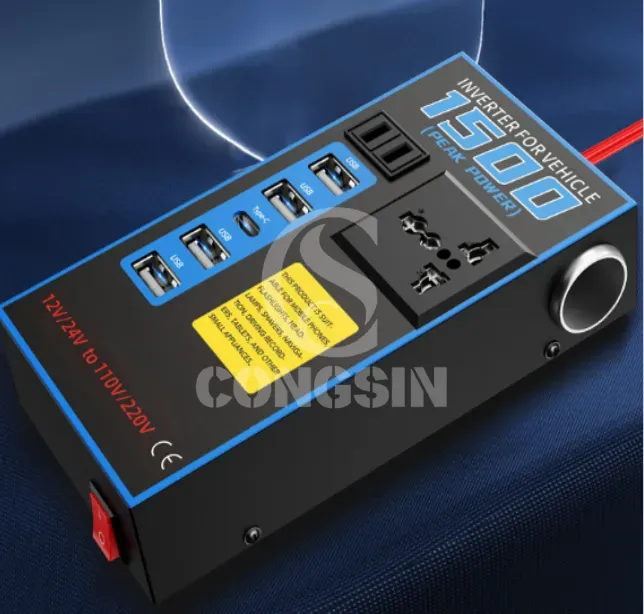
Congsin 1500W Inverter for Vehicle DC 12V/24V to AC 110V/220V with Universal socket Modified Sine Wave
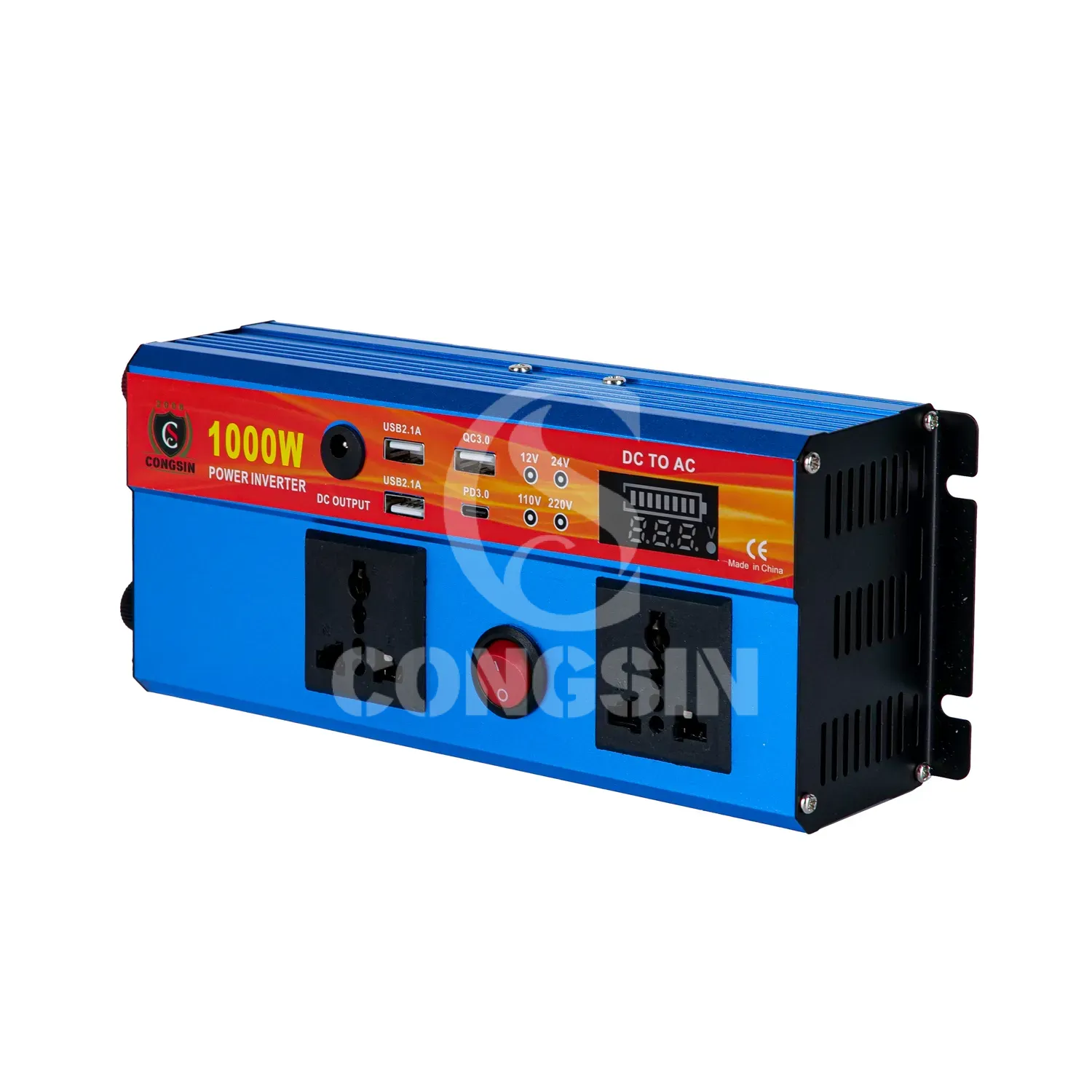
Congsin 1000W modified sine wave inverter with LED display and Type C port car RV power inverter
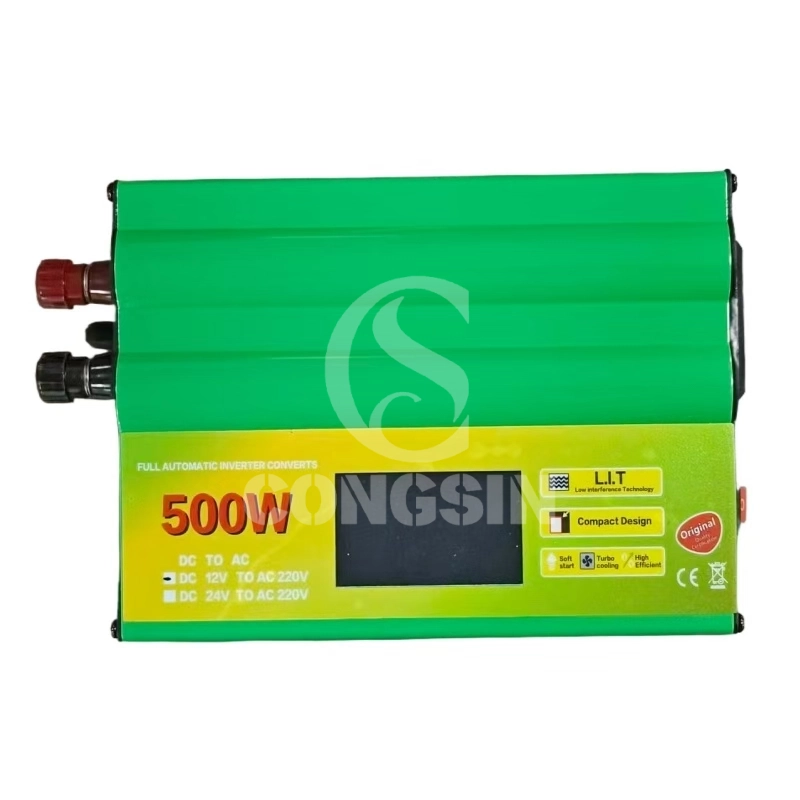
Congsin Modified Sine Wave Inverter 500W 1000W 1500W 12V LED Display Portable for RV Car Solar
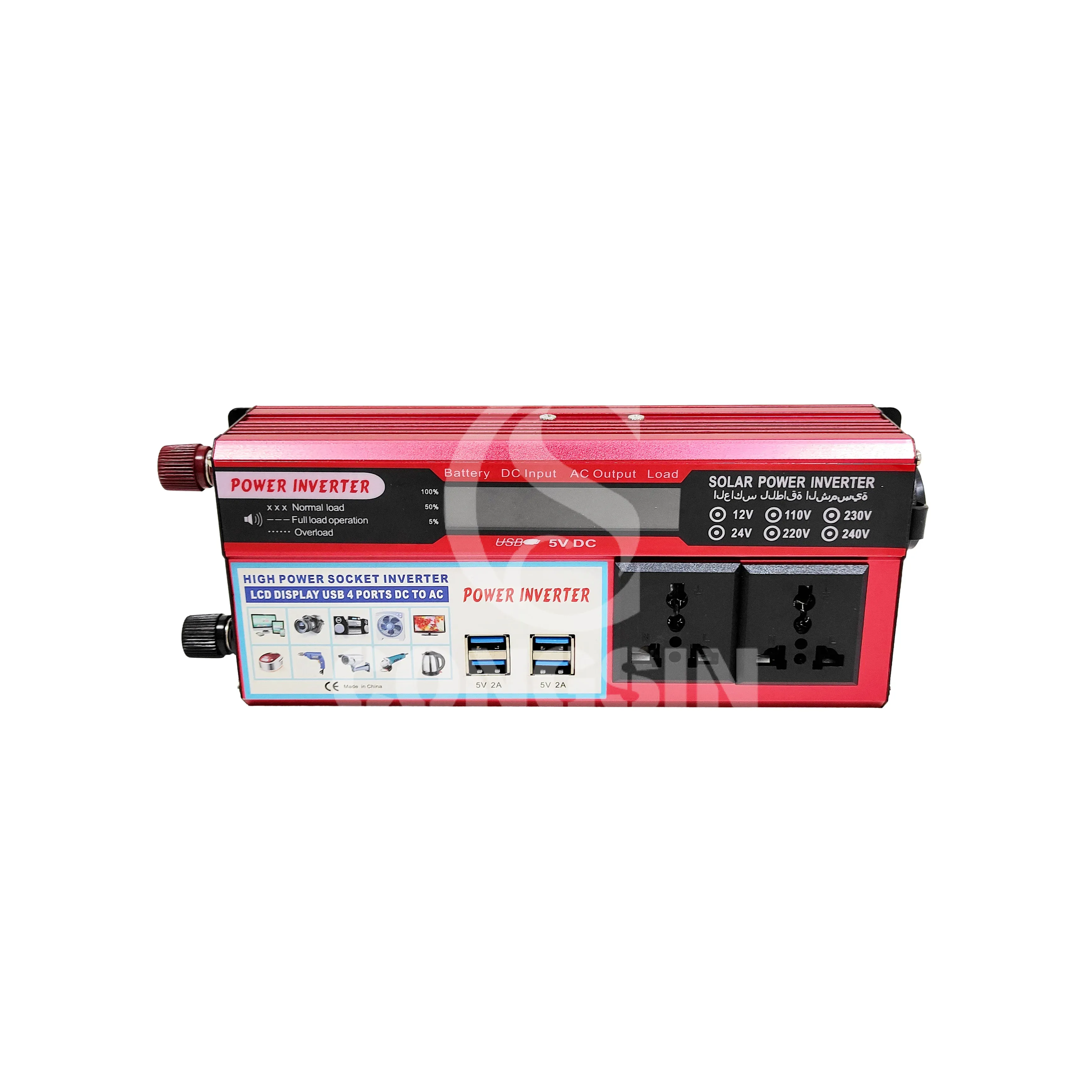
Congsin 1500W modified sine wave inverter with LCD display and USB ports for RV car boat home use

CONGSIN is a trusted OEM factory for power inverters, solar charge controllers, and DC converters. Reliable solutions for global B2B buyers.
 High Quality
 7/24 Service
 Guaranteed Warranty
© 2025 Congsin. All Rights Reserved.